Experimental validation
Experimental Validation Roadmap
Last scientific review: 2026-10-12.
The next phase is proposed laboratory work. Its purpose is to distinguish RNA-processing effects from intrinsic protein effects, while allowing both to contribute. No experiment below is presented as completed or scheduled. Supporting claims: C036proposedC039proposedC042scope
1. Establish whether the RNA junction is used
Compare matched WT and variant contexts, detect native and alternative junctions, and confirm product sequences. Initial minigene or tractable cell work can test sequence-intrinsic effects; it does not reproduce the entire locus or establish retinal relevance. A negative result needs adequate USH2A expression and assay sensitivity. Supporting claims: C036proposed
2. Measure proportions and RNA fate
Quantify native and alternative products with appropriate controls. NMD-aware comparisons should confirm the identity of any recovered abnormal RNA and account for global effects of the perturbation. Total RNA changes or a prominent PCR band alone do not establish product fractions or NMD. Supporting claims: C037proposed
3. Resolve full transcript and isoform identity
Link the candidate junction to transcript ends using suitable transcriptomic approaches. Combine linkage evidence with orthogonal quantification, since sparse long reads cannot establish absence or unbiased abundance. Analyze classical long and short architectures separately. Supporting claims: C038proposedC006annotation
4. Test the missense protein independently
Compare matched intron-free WT and G1526R expression with transcript normalization. A reproducible protein difference under comparable RNA levels would support a separate protein route. Defined-domain biochemistry can test local folding-related behavior, with explicit limits on transfer to native glycosylated full-length usherin. Supporting claims: C039proposedC040proposed
5. Test relevant cellular and isoform contexts
Human-cell, iPSC or retinal-organoid studies could examine processing and localization where the relevant isoforms are expressed. Isoform-specific maturation, turnover and targeted interaction work should follow a reproducible phenotype or supported interface. Materials, facilities and collaborations must be established rather than assumed. Supporting claims: C041proposedC043proposedC042scope
Decisions informed by the results
Sequence-confirmed use of the junction would turn a computational candidate into an observed event in the tested context; quantitative and NMD-aware work would then address its abundance and fate. An intron-free protein effect would support an additional route. Well-controlled negative results would narrow the hypotheses, with cell-context and assay-sensitivity limits retained. Supporting claims: C036proposedC037proposedC039proposed
Any future attempt to alter splicing would require a validated molecular target and separate assessments of specificity, protein consequences and safety. It would remain research; this project has established no therapeutic efficacy or available treatment. Supporting claims: C033unresolved
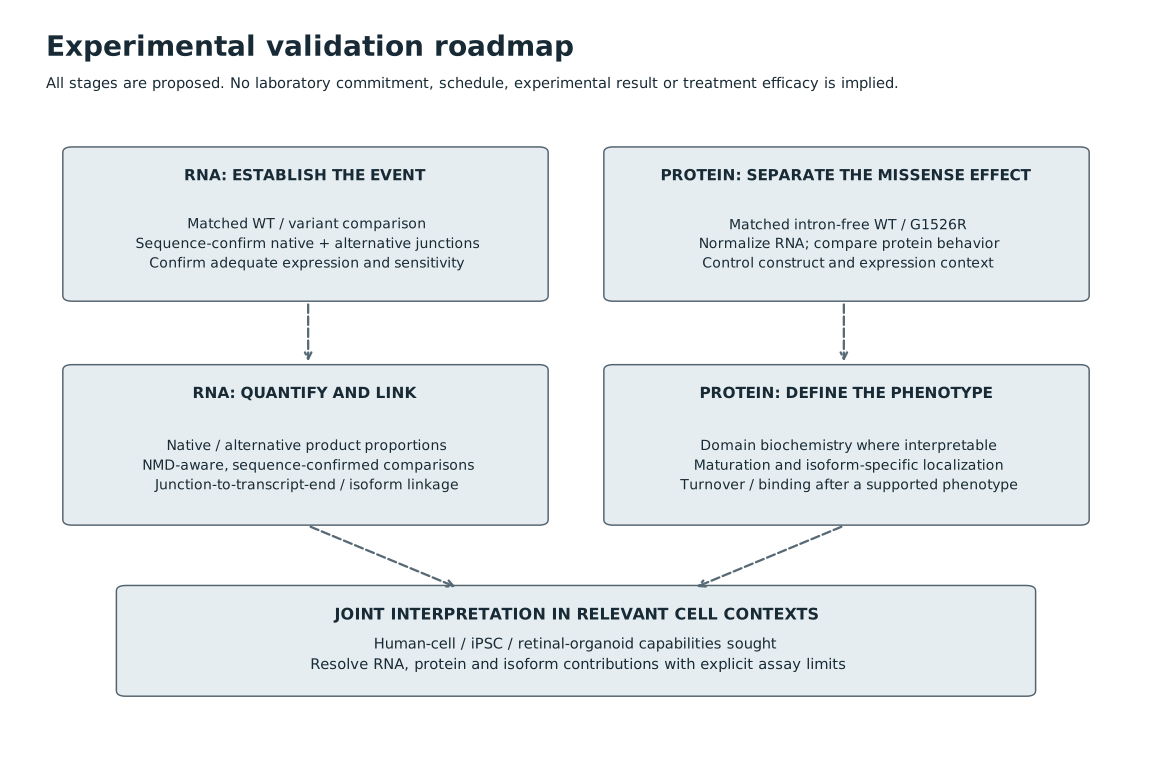
Text description of the figure
Research status
The record below separates completed computation and documentation from proposed laboratory work. Dates are calendar completion dates for the recorded work only; proposed stages have no schedule and no committed laboratory.
Reference identity and isoform mappingCompleted · computation
RNA predictor and reconstruction auditCompleted · computation
Local structure, stability controls and MD assessmentCompleted · computation
Independent-review junction packageCompleted · documentation
Scientific website handoffCompleted · documentation
Sequence-confirmed RNA event testingProposed · not started
RNA quantification, fate and isoform linkageProposed · not started
Independent protein and cellular comparisonsProposed · not started