Project 01 · USH2A G1526R Molecular Mechanism
From a Personal Variant to a Testable Molecular Hypothesis
An independent, patient-initiated investigation of USH2A p.Gly1526Arg.
The nucleotide and amino-acid changes are verified. Three splice models agree on a site-level effect, and one model returns a cryptic donor–exon 22 pair that can be reconstructed into a candidate transcript carrying a 50-nt deletion. Whether that RNA exists, how abundant it would be, and how much normally spliced G1526R protein still functions are unresolved. The project now seeks laboratory partners who can test the resulting questions.Supporting claims: C001sequence factC010predictionC016conditionalC019unresolvedC032unresolvedC042scope
- Transcript
- NM_206933.4:c.4576G>A
- Protein
- NP_996816.3:p.Gly1526Arg
- Genome (GRCh38)
- NC_000001.11:g.216175303C>T
The scientific question
USH2A encodes usherin and is associated in reference databases with Usher syndrome type 2A and nonsyndromic retinitis pigmentosa. Those gene-level associations motivate molecular investigation; they do not specify this variant’s mechanism or predict an individual clinical course.Supporting claims: C003annotation
The reference mapping is verified: USH2A lies on the minus strand, so the genomic and transcript substitutions are complementary, and at the normally spliced coding sequence GGG becomes AGG — glycine replaced by arginine at residue 1526.Supporting claims: C001sequence factC002sequence fact
What is still open is where the damage occurs. Does the change alter how USH2A RNA is spliced, does the amino-acid substitution alter the protein, or do both contribute? The dominant pathogenic mechanism is unknown, and the present evidence cannot quantify the relative contribution of each route.Supporting claims: C032unresolvedC020unresolved
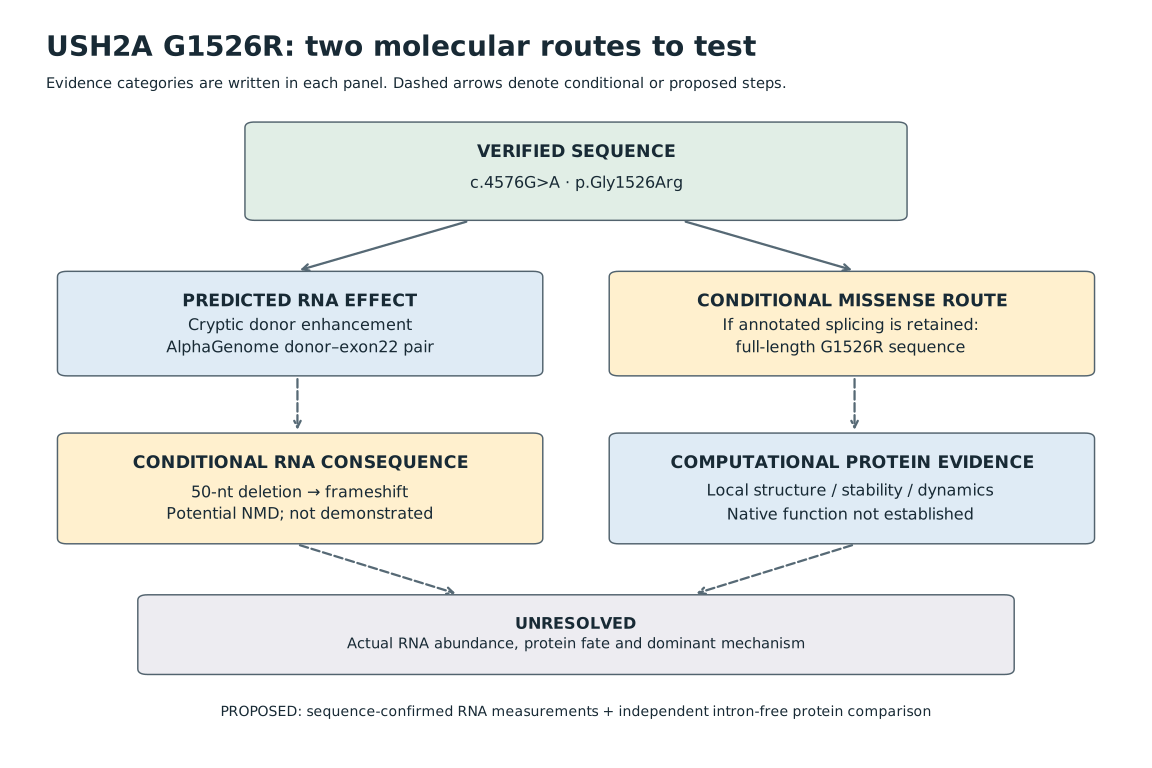
Two candidate routes, one variant
Both routes below are working hypotheses. The RNA route is the clearest candidate to test; neither route has been experimentally established as dominant.
Route A — predicted RNA processing
- USH2A c.4576G>A in exon 21 Sequence fact
- Cryptic donor position enhanced, annotated donor position reduced Computational prediction
- Predicted pair: donor 216175302 → exon-22 acceptor 216097213 Computational prediction
- Candidate transcript carrying a 50-nt deletion: c.4578_4627 deleted Conditional consequence
- Conditional frame: Arg1526–His1527–stop1528 Conditional consequence
- Stop 124 nt before the next junction: NMD-compatible geometry Conditional consequence
Route B — normally spliced protein
- Normally spliced G1526R transcript Sequence fact
- Full-length G1526R usherin retains the annotated membrane and cytoplasmic regions Conditional consequence
- Residual protein function unknown Unresolved question
- Local model differences do not establish native folding, maturation or interactions Unresolved question
Text description of the figure
What has been computed
Four analysis components support the questions above. Their scores use different scales and are never combined or averaged.
RNA site prediction
All three agree on enhancement at the cryptic donor-associated position and reduction at the annotated donor-associated position. Only AlphaGenome supplies an explicit donor–acceptor pair in these runs.Supporting claims: C010prediction
Junction prediction
Proposed junction outputs, unchanged from the model: eye REF 0.0006493872497230768 / ALT 0.005134492181241512; brain REF 0.00025533069856464863 / ALT 0.0007750487420707941. These are not read counts, RNA percentages or probabilities of complete transcripts.Supporting claims: C011predictionC014prediction
Local protein structure
Matched local Cα RMSDs 0.152–0.341 Å partly overlap the within-WT range 0.132–0.230 Å. Target pLDDT 88.69–90.56 (WT) versus 78.00–83.56 (G1526R) is model confidence, not an energy or function score.Supporting claims: C022predictionC023prediction
Stability and dynamics
The primary Rosetta run failed geometry qualification in 26 of 30 mutant structures, so its large positive values were excluded. More-flexible runs gave +13.706 / +9.135 REU; ThermoMPNN forward means were +1.288 / +1.306 predicted kcal/mol with reverse means near +0.060 / +0.058. REU and predicted kcal/mol are not interchangeable. Paired 20-ns simulations showed local RMSD differences of −0.664 to +1.185 Å that reversed direction.Supporting claims: C024predictionC025predictionC026predictionC028prediction
What remains unknown
This list is the scientific centre of the project. None of it is a negative result; it is an evidence gap.
- Whether the predicted deletion-containing splice product exists in cells, and what the actual abnormal RNA fraction would be.C019unresolved
- NMD efficiency: a premature stop with compatible geometry does not measure decay or transcript depletion.C018conditional
- Functional protein abundance and residual G1526R protein function in a native, glycosylated, full-length context.C029unresolvedC031conditional
- Isoform-specific consequences: the classical short transcript terminates in exon 21, so the long-form 50-nt-deletion reconstruction cannot be transferred to it.C006annotationC020unresolved
- Cellular disease relevance: the selected model tracks are embryonic camera-type eye and adult brain, neither of which is a retina or photoreceptor assay.C012prediction
- Therapeutic value: no therapeutic efficacy has been established by this project, and a proposed splicing-restoration approach is a research hypothesis, not an available treatment.C033unresolved
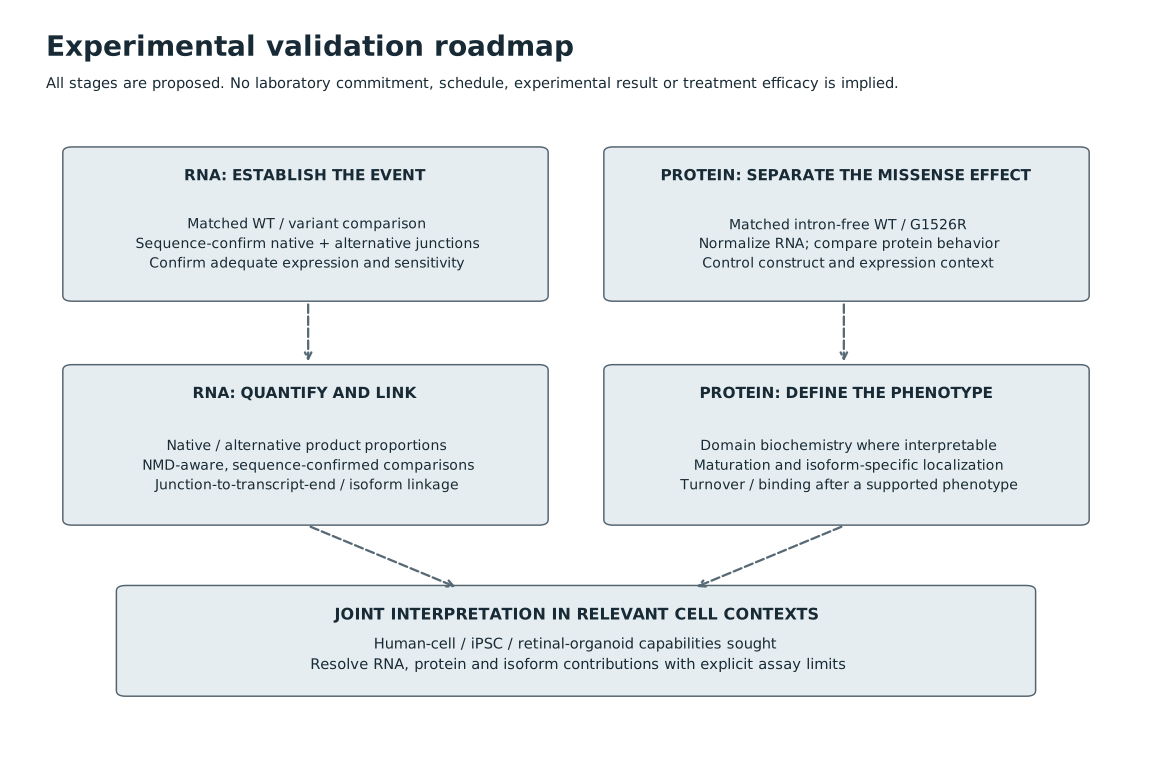
The experimental roadmap
Every stage below is proposed, not started, and no laboratory is represented as committed. The order reflects what would resolve the most uncertainty first.
- Establish whether the RNA junction is used — matched WT and variant contexts, sequence-confirmed products.
- Measure proportions and RNA fate — quantitative, NMD-aware comparison of native and alternative products.
- Resolve full transcript and isoform identity — junction-to-transcript-end linkage, long and short architectures analysed separately.
- Test the missense protein independently — matched intron-free constructs with transcript normalization.
- Test relevant cellular and isoform contexts — human-cell, iPSC or retinal-organoid systems where the relevant isoforms are expressed.
Text description of the figure
Where collaborators are needed
- RNA splicing biology: cryptic and annotated donor use in matched backgrounds, junction confirmation.
- Transcriptomics: linking alternative junctions to transcript ends with isoform-aware controls.
- Human-cell functional validation: intron-containing versus intron-free designs with matched RNA and protein measurements.
- iPSC and retinal organoids: relevant expression and developmental context.
- Protein biochemistry: defined WT/G1526R constructs for maturation and folding-related behaviour.
- Isoform-specific functional studies: long and short architectures tested separately.
Starting a conversation
Write to president@usher.org.tw with the hypothesis you could test, the expression context you work in and the readouts you could provide.
Research status
Reference identity and isoform mappingCompleted · computation
RNA predictor and reconstruction auditCompleted · computation
Local structure, stability controls and MD assessmentCompleted · computation
Independent-review junction packageCompleted · documentation
Scientific website handoffCompleted · documentation
Sequence-confirmed RNA event testingProposed · not started
RNA quantification, fate and isoform linkageProposed · not started
Independent protein and cellular comparisonsProposed · not started
Read the proposed experiments · Download the evidence tables