Molecular evidence
Molecular Evidence
Last scientific review: 2026-10-12.
RNA Splicing Evidence
SpliceAI, Pangolin and AlphaGenome agree on enhancement at the cryptic donor-associated site and reduction at the annotated donor-associated site. This agreement concerns site-level predictions. Only AlphaGenome supplies the explicit donor–acceptor pair in these runs; Pangolin’s executed classification head does not separately identify donor and acceptor types. 6 7 8 Supporting claims: C010prediction
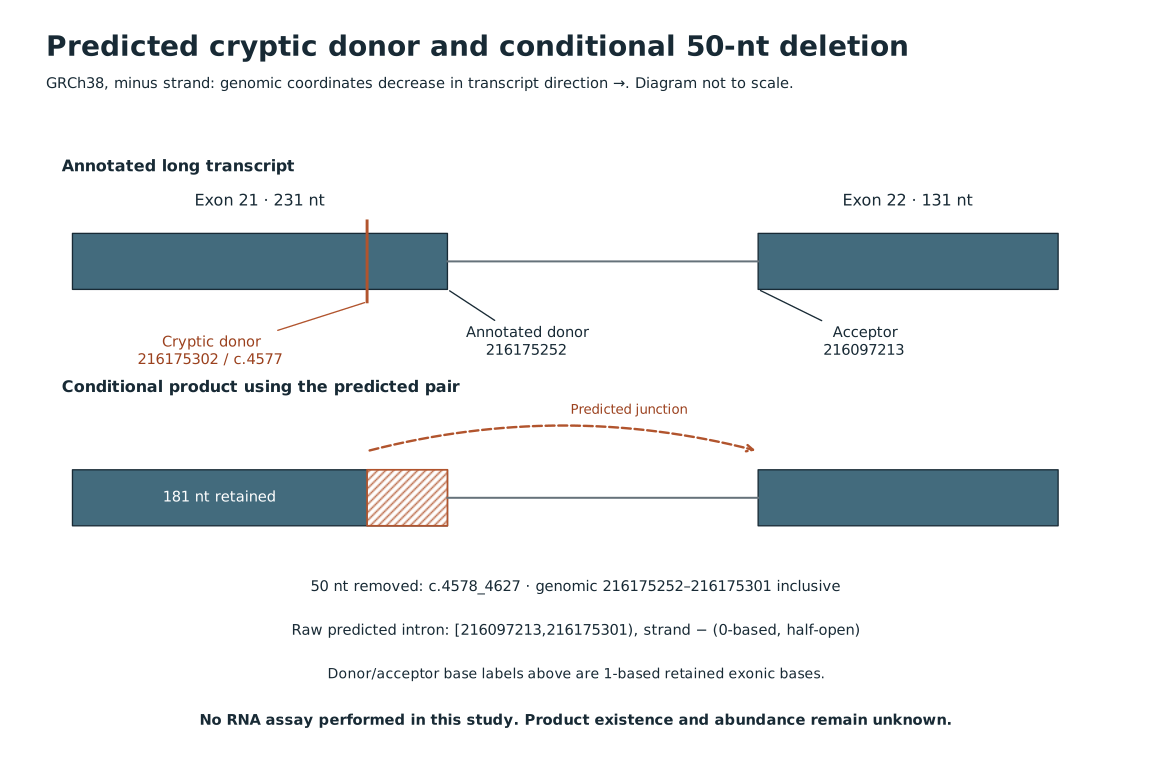
For the 1-Mb input, AlphaGenome returned the minus-strand intron [216097213,216175301), using a 0-based half-open convention. This corresponds to last-retained donor base 216175302 and first-retained acceptor base 216097213, both 1-based genomic coordinates. The annotated donor is 216175252. Supporting claims: C011predictionC016conditional
The exon-22 acceptor ranks first by ALT output among the cryptic donor’s 98 returned partners in both selected tracks. However, the annotated exon21–exon22 junction still has a higher ALT prediction. The preferred cryptic pairing must not be described as the dominant RNA product. Supporting claims: C013prediction
| Proposed cryptic junction | REF prediction | ALT prediction |
|---|---|---|
| Embryonic camera-type eye | 0.0006493872497230768 | 0.005134492181241512 |
| Adult brain | 0.00025533069856464863 | 0.0007750487420707941 |
These are original model outputs. They are not measured read counts, RNA percentages or probabilities of complete transcripts. Supporting claims: C014prediction
The 1,048,576-bp input covers this junction; the 131,072-bp input excludes its acceptor and cannot test the same pair. Embryonic camera-type eye is not a retina or photoreceptor assay, and adult brain is an additional context rather than retinal validation. Supporting claims: C012prediction
Competing pairings remain visible in the evidence tables: intronic acceptors 216111456 and 216111459, exon-23 acceptor 216089139, an internal exon-22 acceptor at 216097159, a weak short-terminal-exon candidate at 216175102, and a weak whole-exon21-skipping comparator. Some pairings do not define a complete onward RNA path. Supporting claims: C015prediction
Text description of the figure
Conditional RNA Consequences
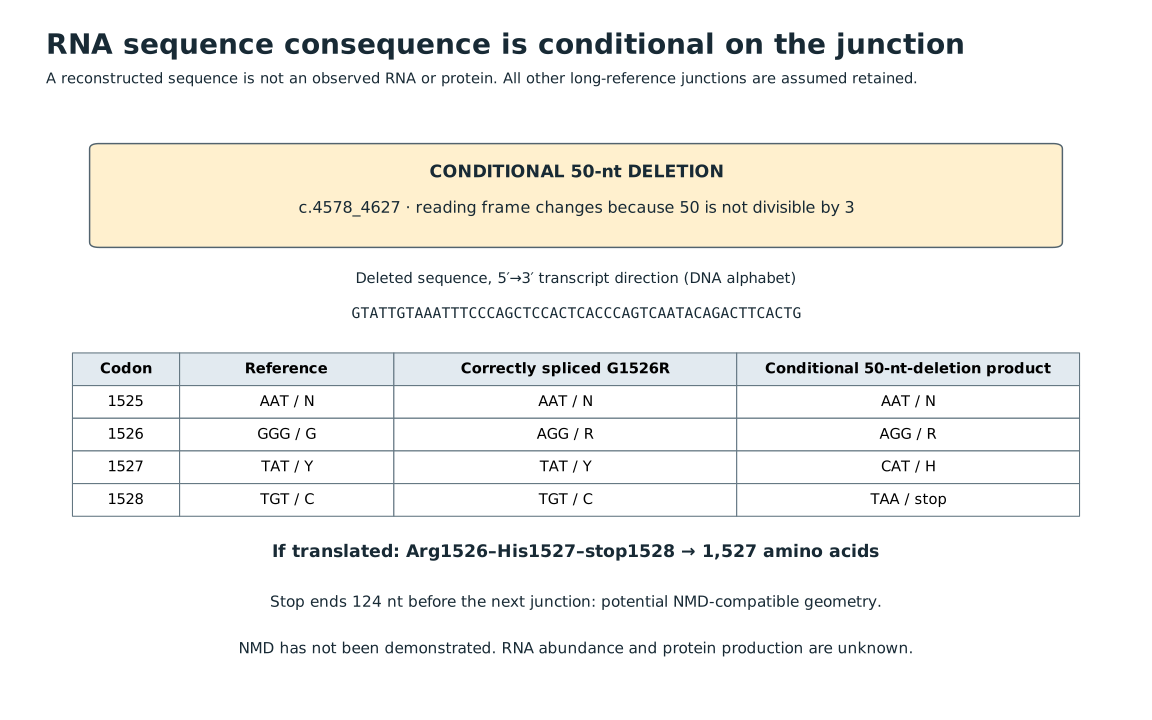
Using the predicted cryptic-to-exon22 junction while retaining all other long-reference processing deletes c.4578_4627, exactly 50 nt. The deleted interval is transcript bases 5017–5066 or genomic bases 216175252–216175301, inclusive. This mature RNA is reconstructed from the prediction and reference transcript; AlphaGenome did not directly output it. Supporting claims: C016conditional
The resulting reading frame encodes Arg1526–His1527–stop1528, corresponding to a 1,527-amino-acid product if translated. The premature stop ends 124 nt before the next junction, a positional configuration compatible with potential NMD. The presence of such a stop does not demonstrate RNA decay or protein production. Supporting claims: C017conditionalC018conditional
The predicted deletion-containing splice product has not been experimentally observed in this project. Actual abnormal RNA abundance is unknown. No RNA assay was performed, so this limitation must not be presented as a negative experimental finding. Supporting claims: C019unresolved
Text description of the figure
Protein Structural Analysis
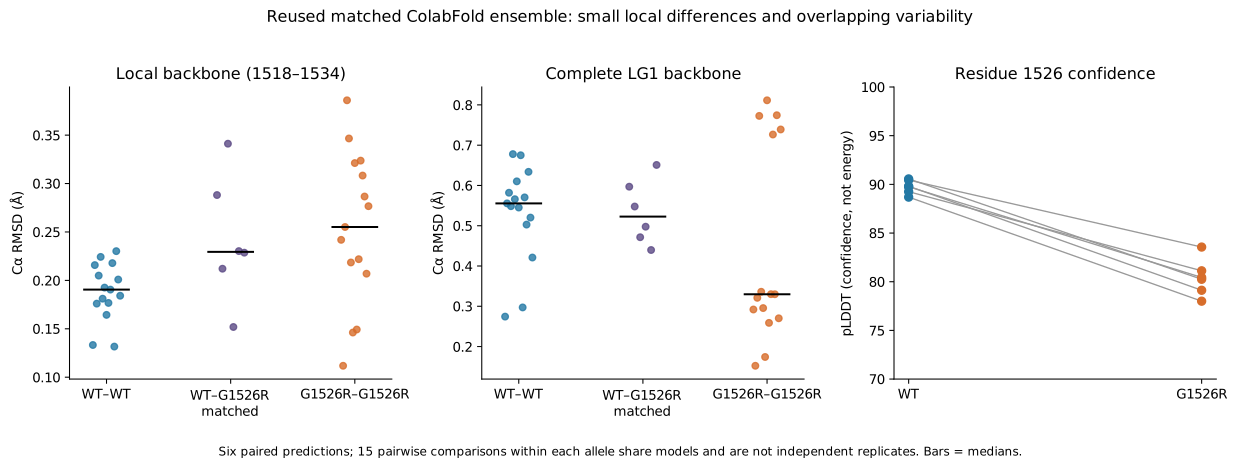
Six WT/G1526R pairs of local ColabFold/AlphaFold2 models were compared using matched model parameters and seeds. The construct spans residues 1364–1709. Local Cα RMSDs were 0.152–0.341 Å, partly overlapping the 0.132–0.230 Å variation among WT models; this does not establish a large local backbone disruption. 9 10 Supporting claims: C021predictionC022prediction
Target pLDDT was 88.69–90.56 in WT and 78.00–83.56 in G1526R models. These confidence values are not native-function scores. Small predicted structural differences also do not exclude altered folding, processing or cellular behavior. Supporting claims: C023predictionC029unresolved
The primary Rosetta calculation failed geometry qualification in 26 of 30 mutant structures. Its large positive values were excluded from native-stability conclusions. Two more-flexible calculations removed gross geometry flags and gave +13.706/+9.135 REU, but protocol dependence and positive reverse controls still prevented a calibrated native folding-energy estimate. 11 Supporting claims: C024predictionC025prediction
ThermoMPNN forward means were +1.288 and +1.306 on its predicted kcal/mol scale for two input contexts; reverse means were approximately +0.060 and +0.058. This is a limited, model-dependent destabilization lead, not a measured native free-energy change. Its scale is not interchangeable with Rosetta REU. 12 Supporting claims: C026predictionC025prediction
Three paired 20-ns WT/G1526R MD comparisons, plus a preserved 5-ns preparation sensitivity, total 125 ns. Local RMSD differences across pairs reversed direction in the common 10–20 ns window (−0.664 to +1.185 Å). No uniform dynamic defect or equilibrium convergence was established in the modeled isolated LG1 domain. 13 Supporting claims: C027predictionC028prediction
AlphaFold, Rosetta and MD do not establish native protein function in this study. Supporting claims: C029unresolved
View the raw-junction review archive · Browse evidence and methods