Research overview
Research Overview
Last scientific review: 2026-10-12.
This patient-initiated project investigates how the public USH2A variant c.4576G>A, p.Gly1526Arg (G1526R), might affect RNA processing and protein behavior. Its purpose is to turn reproducible computational observations into clearly defined laboratory questions. Supporting claims: C001sequence factC034scope
The work currently comprises reference-sequence verification, splice prediction, conditional RNA reconstruction and local protein modeling. This handoff adds no new molecular predictions or laboratory results. Supporting claims: C044scope
What the current evidence supports
Known from sequence and annotation: the nucleotide and amino-acid changes are verified, and the classical long and short isoforms have different terminal architectures. 1 2 Supporting claims: C001sequence factC002sequence factC004sequence factC006annotation
Computationally predicted: three models identify a concordant splice-site effect. AlphaGenome additionally predicts a cryptic donor–exon22 pair that can be used to reconstruct a 50-nt deletion in the long transcript. The RNA-splicing route is therefore a priority for testing, not an established predominant mechanism. 6 7 8 Supporting claims: C010predictionC011predictionC016conditionalC032unresolvedC036proposed
Not demonstrated: the predicted deletion-containing splice product has not been experimentally observed in this project. Actual abnormal RNA abundance is unknown; NMD has not been experimentally demonstrated. Protein calculations do not establish native function. Supporting claims: C018conditionalC019unresolvedC029unresolved
The dominant pathogenic mechanism is unknown. RNA and protein effects could coexist, and isoform-specific functional contributions remain unresolved. Supporting claims: C020unresolvedC032unresolved
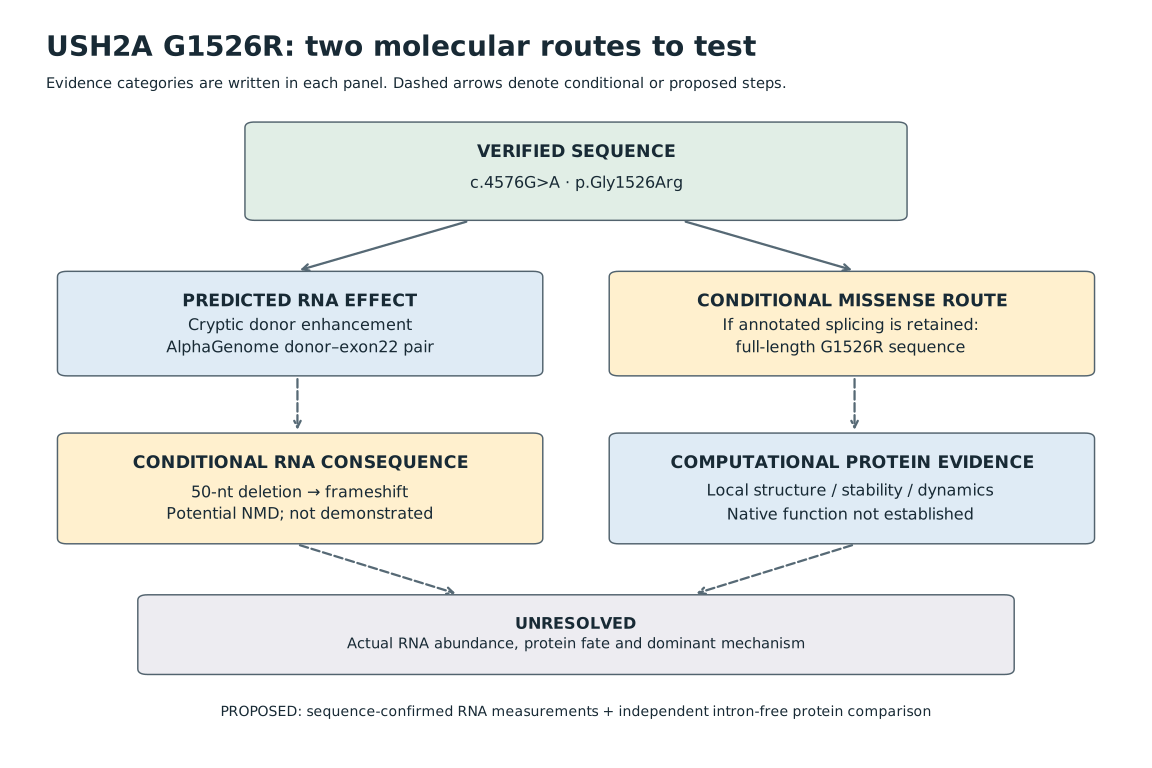
Text description of the figure
Why collaboration matters
Sequence-confirmed RNA measurements, followed by quantitative and isoform-aware analysis, can test whether the predicted junction is used. A matched intron-free protein comparison can separately test the amino-acid substitution. These complementary measurements address gaps that the present models cannot resolve. Supporting claims: C036proposedC037proposedC038proposedC039proposed
The project seeks laboratory expertise rather than presenting an established treatment program. No therapeutic efficacy has been established by this project. A proposed splicing-restoration approach is a research hypothesis, not an available treatment. Supporting claims: C033unresolvedC042scope
Explore the molecular evidence · Review the proposed experiments · Collaboration areas